
The Hang Seng Index is one of Asia’s best-known stock market benchmarks. It gives investors a quick view of major companies listed in Hong Kong. For US readers, understanding the Hang Seng Index HSI can provide useful context about Hong Kong stocks, Chinese businesses, and wider Asian financial markets. However, the index is more than a number moving up or down on a trading screen.
Its value reflects changes in large companies, investor expectations, economic conditions, and global market sentiment. This guide explains the HSI index in simple terms. You will learn about its history, calculation, major companies, sectors, importance, risks, and ways to track or invest in it.
What Is the Hang Seng Index (HSI)?
The Hang Seng Index is a major stock market index that tracks selected large companies listed on the Hong Kong Stock Exchange. The exchange is commonly known as HKEX. The index is widely used as a benchmark index for the Hong Kong stock market. It helps investors understand how a group of prominent Hong Kong-listed shares is performing.
The Hang Seng Index HSI does not represent every company on the exchange. Instead, it follows a selected group of leading businesses. These companies come from different industries. Their combined performance helps create a broad picture of the local equity market. For US investors, the HSI can also offer a window into businesses connected with China and the wider Asian economy.
The HSI is especially important because Hong Kong acts as a major bridge between mainland China and international capital. Many mainland Chinese companies raise capital or list shares in Hong Kong. As a result, movements in the index can reflect both local conditions and changing expectations about China economic development.
What Does the Hang Seng Index Represent?
The HSI represents the performance of its selected constituent stocks. When heavily weighted companies rise, the index may climb. When several large constituents fall, the index can decline even if smaller shares perform well. This structure makes company weighting an important part of understanding the index.
For example, imagine a large technology company with a huge market value and a smaller retailer. A sharp move in the technology stock may affect the index much more. The retailer’s movement may barely register. Therefore, the HSI is useful as a market benchmark but does not perfectly represent every corner of the Hong Kong market.
History and Evolution of the Hang Seng Index
The Hang Seng index history began in 1969. Hang Seng Bank introduced the index as a way to measure the performance of major Hong Kong-listed companies. Since then, it has developed into one of the most watched benchmarks in the Asian stock market. Its long history also provides a useful record of changing investor confidence across several economic cycles.
Over the decades, the HSI has changed alongside Hong Kong’s economy. The market once had stronger exposure to traditional industries such as finance, property, and utilities. Later, technology and consumer businesses became increasingly important. The growing presence of Chinese companies also changed the index’s character. Today, its performance can be influenced by both Hong Kong conditions and broader mainland Chinese developments.
Key Milestones in Hang Seng Index History
The evolution of the HSI mirrors the transformation of Hong Kong into a global financial center. Economic expansion, financial crises, property cycles, technology growth, and changing regulations have all influenced its path. Major global events have also created periods of sharp stock price movements and elevated market volatility.
The index has also experienced substantial shifts in investor sentiment. During periods of optimism, expectations for corporate earnings and economic growth can push valuations higher. During difficult periods, concerns about regulation, interest rates, geopolitics, or economic weakness can pressure prices. Studying historical index data therefore helps investors understand how the HSI has responded to different environments.
How Is the Hang Seng Index Calculated?
The Hang Seng index calculation uses a free-float-adjusted market capitalization approach. In simple terms, companies with larger eligible market values generally have greater influence on the index. The calculation also considers the shares that are actually available for public trading. This methodology makes the HSI a market capitalization weighted index rather than a simple average of stock prices.
The concept may sound complicated at first. However, the basic idea is straightforward. A company with a large market value can have a bigger effect on the index than a much smaller company. The free-float adjusted approach also focuses on publicly traded shares rather than every share a company has issued. This helps make the index more representative of investable market value.
What Is Free-Float Adjustment?
Free float refers broadly to shares that are available for public trading. Some shares may belong to governments, controlling shareholders, strategic investors, or insiders. These holdings may not trade regularly. Therefore, the index methodology adjusts for the portion of shares that investors can realistically buy and sell.
This approach matters because total shares can sometimes give a misleading picture of actual trading availability. By considering publicly available shares, the methodology provides a better view of the investable portion of a company’s equity. The result is a more practical representation of the market for international investors and other participants.
How Are Companies Weighted in the HSI?
The HSI uses company weighting to determine how much influence each constituent has. A large company with substantial eligible market capitalization can affect the index more than a smaller business. However, index rules can limit excessive concentration through weighting controls and other methodology provisions.
The calculation also uses an index divisor. The divisor helps maintain continuity when corporate actions change a company’s share structure. Stock splits, bonus issues, and other adjustments can change share prices without creating a genuine change in total investor wealth. The index calculation formula accounts for such events so the index remains comparable over time.
Hang Seng Index Constituents and Major Companies
The Hang Seng index constituents are the companies included in the benchmark. These Hang Seng index companies represent important parts of Hong Kong’s listed corporate sector. Their selection depends on index rules and review processes. The composition can change as companies grow, shrink, become more liquid, or no longer meet eligibility requirements.
The HSI has historically included prominent names from finance, technology, consumer businesses, telecommunications, and property. These major companies can attract significant attention from investors around the world. However, the exact list and weighting can change. Anyone researching the Hang Seng index stocks should check the latest official information rather than relying on an old article.
How Are Hang Seng Index Companies Selected?
The selection process considers factors such as market size, liquidity, listing status, and overall representation. The goal is to create an index that captures important parts of the Hong Kong equity market. It is not simply a list of the biggest businesses by revenue or profit.
The methodology also aims to maintain suitable sector representation. This matters because an index dominated by one industry may provide a narrow view of the market. By including businesses from different fields, the HSI can offer a more balanced snapshot of major listed companies.
| Feature | What It Means |
| Constituent companies | Selected companies included in the HSI |
| Market capitalization | The market value of a company’s outstanding shares |
| Free float | Shares generally available for public trading |
| Weighting | The influence a company has on index movements |
| Index review | A process that can change the constituent list |
| Index divisor | A calculation adjustment that maintains continuity |
Sectors Represented in the Hang Seng Index
The Hang Seng index sectors cover several important areas of the economy. Financial businesses have traditionally played a major role because Hong Kong is a global financial center. The index can also include technology companies, consumer businesses, property firms, telecommunications groups, utilities, and other industries.
This broad sector representation gives investors a more varied view than a single-industry benchmark. However, sector weights are not fixed forever. Economic changes can increase the importance of technology or consumer companies. Meanwhile, property, banking, and other traditional sectors can gain or lose influence as market conditions change.
Which Sectors Have the Biggest Influence on the HSI?
Financial services remain an important part of Hong Kong’s market structure. Financial services companies include businesses involved in banking and insurance and other financial activities. Their performance can respond to interest rates, credit conditions, economic growth, and investor confidence.
Other sectors can also shape the index. Technology companies may react strongly to regulation and innovation trends. Real estate companies can respond to property prices and financing costs. Telecommunications companies often have different earnings patterns. The utilities sector may provide relatively defensive exposure. Meanwhile, commerce and industry businesses can respond to consumer demand and global trade.
Why Is the Hang Seng Index Important?
The HSI matters because it provides a widely followed measure of major Hong Kong-listed equities. Analysts, traders, financial institutions, and global investors often watch its movements. Changes in the index can offer clues about investor sentiment, risk appetite, and expectations for corporate earnings.
The index also has importance beyond Hong Kong. Its constituents include businesses with strong connections to mainland China and international markets. Therefore, the HSI can provide useful China market exposure for analysis. Still, it should not be viewed as a complete measure of China’s economy. China’s economic performance is much broader than the companies represented in one Hong Kong benchmark.
Why Do US Investors Watch the Hang Seng Index?
For US investors, the HSI can provide a useful reference point when studying global markets. It can reveal how investors are reacting to developments in China and Hong Kong. It can also highlight shifts in Asian risk appetite before US markets open.
However, investors should remember that index performance and personal investment returns are not always identical. Currency movements, taxes, fees, trading costs, and the structure of an investment product can affect actual returns. A US investor may therefore need to consider both the HSI and the US dollar value of any investment.
What Factors Affect the Hang Seng Index?
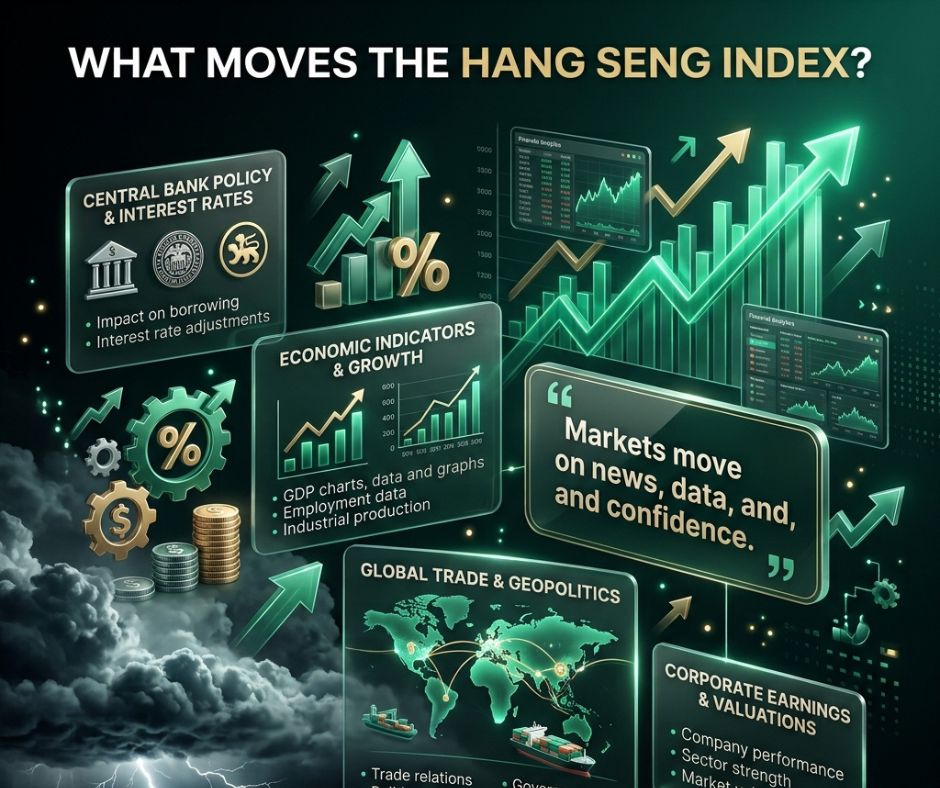
Several forces can move the HSI at the same time. China’s economic growth is one major factor. Corporate earnings, property conditions, consumer spending, government policies, and trade activity can all influence companies listed in Hong Kong. When investors expect stronger growth, share valuations may improve. When expectations weaken, prices can fall.
Global conditions also matter. Interest rate changes, inflation, US Federal Reserve policy, trade disputes, and geopolitical events can influence capital flows. Because Hong Kong is deeply connected to international financial markets, the HSI can respond quickly to global developments. That makes global economic conditions an important part of understanding daily movements.
How Do China and US Markets Affect the HSI?
The relationship between the HSI and US markets can be surprisingly strong during periods of global stress. A major move in US technology stocks may influence sentiment toward Asian technology shares. Likewise, changes in US interest rates can affect global borrowing costs and investor demand for riskier assets.
China-specific developments can create another layer of movement. New regulations may affect technology companies. Trade policies can influence exporters. Economic stimulus can improve expectations. Conversely, concerns about growth can increase uncertainty. These factors can change financial market conditions rapidly.
How Does Currency Movement Affect the Hang Seng Index?
Currency matters because US investors measure their wealth in dollars. The Hong Kong dollar has a close relationship with the US dollar through Hong Kong’s linked exchange rate system. Still, international investment products may have their own currency effects and expenses.
Suppose a US investor buys an investment linked to Hong Kong stocks. The index may rise during the investment period. Yet the investor’s final dollar return can differ because of currency movements, fees, and tracking differences. Understanding this distinction is essential for effective index performance tracking.
How to Track the Hang Seng Index
Tracking the HSI is relatively simple. Financial news websites, brokerages, market-data platforms, and charting services commonly provide information about the index. You may see the current level, daily percentage change, trading range, and historical charts. Some platforms also provide real-time index data while others display delayed information.
Searching for Hang Seng index today can help you find the latest market discussion. Searching for Hang Seng index live may help locate current price information. However, always check the timestamp and data source. A delayed quote can tell a very different story during a fast-moving trading session.
What Should You Check When Tracking the HSI?
The Hang Seng index performance should not be judged by one number alone. Look at the percentage change, trading volume, sector movements, and performance of major constituents. Historical comparisons can also show whether a move is unusually large or part of a longer trend.
For better index performance tracking, combine price data with economic news and company developments. If the index falls sharply, ask why. Was the move caused by technology stocks, property companies, interest rates, or broader global fear? That extra context turns a simple number into useful market information.
| Metric | Why It Matters |
| HSI index value | Shows the current benchmark level |
| Daily percentage change | Measures short-term movement |
| Trading volume | Indicates market activity |
| Sector performance | Shows which industries drive the move |
| Constituent performance | Identifies influential individual stocks |
| Historical data | Provides longer-term context |
| Economic news | Explains possible market drivers |
How to Invest in or Trade the Hang Seng Index
You cannot normally buy an index itself like you buy an individual stock. Instead, investors seek Hang Seng index investment exposure through financial products designed to follow the benchmark. These may include exchange-traded funds, index funds, futures, options, or individual companies.
A Hang Seng index ETF can offer a convenient route for some investors. An ETF may hold a portfolio designed to track the underlying benchmark. Hang Seng index funds can serve a similar purpose. However, each product has its own fees, structure, liquidity, and tracking characteristics. Investors should read the fund documents carefully before committing money.
Can US Investors Invest in the Hang Seng Index?
US investors may gain exposure to Hong Kong equities through eligible brokerage accounts and investment products. An ETF tracking the Hang Seng Index can potentially provide diversified access to multiple companies through one security. However, product availability varies between brokers and jurisdictions.
Another option involves investing directly in individual Hong Kong-listed companies. This approach can provide targeted exposure but may increase company-specific risk. By contrast, diversified investment can spread exposure across multiple businesses. Investors should still consider fees, taxes, currency effects, and their own risk tolerance.
Hang Seng Index Investment Risks
Every international investment carries risk. HSI exposure can involve political uncertainty, regulatory changes, currency considerations, and sector-specific risks. Technology businesses may face changing regulations. Property companies may struggle when borrowing costs rise. Financial firms may react to economic stress.
Market volatility can also be significant. Global investors may rapidly change their positions when sentiment shifts. Therefore, portfolio diversification can help manage concentration risk. It cannot guarantee profits or prevent losses. The right approach depends on your goals, time horizon, and willingness to accept risk.
Hang Seng Index vs Other Major Stock Market Indexes
Comparing the HSI with other benchmarks helps put its role into perspective. The S&P 500 tracks large US companies. The Nasdaq Composite has strong exposure to technology and growth businesses. The Nikkei 225 represents major Japanese stocks. The Shanghai Composite reflects a different segment of China’s mainland market.
The HSI has its own identity. It focuses on selected Hong Kong-listed businesses and includes companies connected to both Hong Kong and mainland China. As a result, its stock market performance can respond to different forces than US or Japanese benchmarks. Comparing indexes can therefore help you understand regional differences in economic exposure and investor expectations.
| Index | Main Market Exposure | Key Difference |
| Hang Seng Index | Hong Kong-listed companies | Strong connection to Hong Kong and China |
| S&P 500 | Large US companies | Broad US large-cap exposure |
| Nasdaq Composite | US-listed stocks | Strong technology presence |
| Nikkei 225 | Japanese companies | Major Japanese equity benchmark |
| Shanghai Composite | Mainland China | Focuses on Shanghai-listed shares |
| CSI 300 | Mainland China | Tracks major Shanghai and Shenzhen companies |
Hang Seng Index vs S&P 500
The HSI and S&P 500 represent different economies and investment environments. The S&P 500 gives broad exposure to large US corporations. The HSI provides exposure to major companies listed in Hong Kong. Their sectors, currencies, regulations, and economic drivers differ.
For US investors, the comparison can highlight the benefits and challenges of international diversification. However, the two benchmarks should not be treated as interchangeable. A rise in one does not automatically predict a rise in the other.
Hang Seng Index vs Shanghai Composite
The HSI and Shanghai Composite both relate to China’s broader financial ecosystem. Yet they represent different markets. The HSI focuses on selected companies listed in Hong Kong. The Shanghai Composite covers stocks listed on the Shanghai Stock Exchange.
This difference matters because companies can respond differently to local regulations, investor access, currency conditions, and capital flows. Therefore, investors seeking China market exposure should understand which benchmark they are actually following.
Frequently Asked Questions
What is the Hang Seng Index?
The Hang Seng Index is a major benchmark that tracks selected large companies listed on the Hong Kong Stock Exchange. It is widely followed as a measure of major Hong Kong-listed equities and broader investor sentiment toward the region.
What does the Hang Seng Index measure?
The HSI measures the performance of its selected constituent companies. Because these businesses operate across different industries, the index provides a broad snapshot of major Hong Kong-listed shares. It does not represent every stock or every part of the Hong Kong economy.
How many companies are in the Hang Seng Index?
The index has historically been associated with a group of 50 constituents. However, the exact composition and methodology can change. Readers should check the latest official index information when researching the current Hang Seng index constituents.
How is the Hang Seng Index calculated?
The HSI uses a free-float-adjusted market capitalization methodology. This means eligible companies receive weights based on their market value and the shares available for public trading. The index divisor also helps maintain continuity when corporate actions change share structures.
Why is the Hang Seng Index important?
The HSI is important because it acts as a major market benchmark for Hong Kong-listed equities. It is closely watched by investors and analysts worldwide. It also offers useful insight into market expectations surrounding Hong Kong and companies connected with mainland China.
Conclusion
The Hang Seng Index is far more than a market number displayed on a financial website. It provides a useful snapshot of major Hong Kong-listed companies and offers insight into investor expectations across an important part of Asia. Its performance can reflect corporate earnings, economic growth, interest rates, regulation, geopolitical developments, and global risk appetite.
For US readers, understanding the HSI can strengthen your knowledge of international markets. It can also help you evaluate Hong Kong stocks, Chinese businesses, and wider Asian financial markets. However, the index has risks that deserve careful attention. Currency exposure, market volatility, regulatory changes, and geopolitical uncertainty can all affect investment outcomes.
The best way to understand the HSI is to look beyond the headline number. Study its index composition, sector exposure, major companies, methodology, and economic drivers. Then compare those factors with global market trends. Whether you are researching the Hang Seng index today, exploring Hang Seng index funds, or learning about international index investing, this broader perspective can help you make better-informed decisions.
