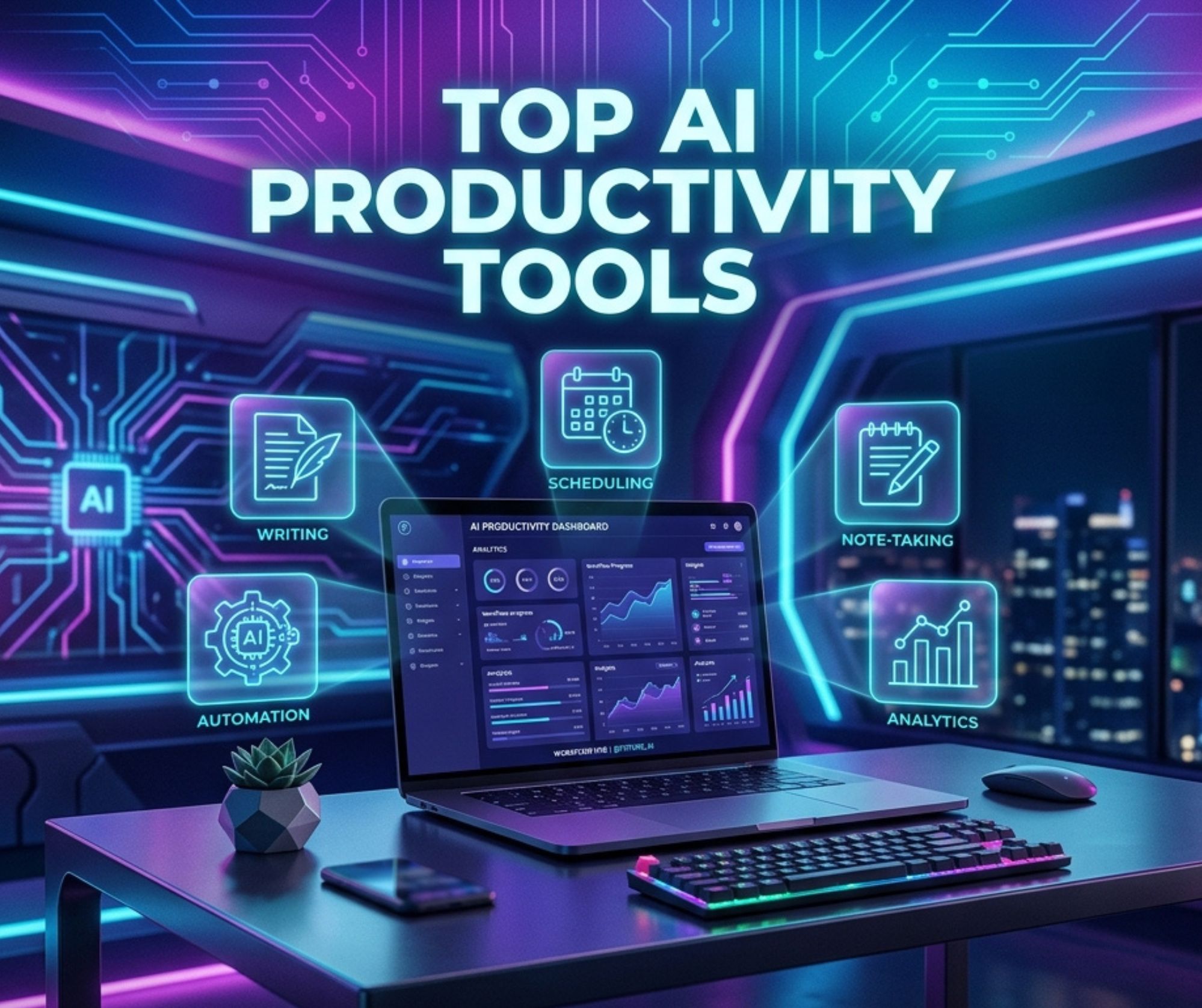
The Top AI Productivity Tools are changing how people work by making daily tasks faster, smarter, and more organized. Instead of relying on separate apps, professionals now combine AI productivity tools, AI workflow tools, AI collaboration tools, Productivity software, and Workflow automation to create a connected digital workspace. This approach reduces manual work, improves communication, and helps teams complete projects with greater accuracy.
Whether you are a freelancer, business owner, student, or remote employee, choosing AI tools that work together can save hours every week. In this guide, you’ll discover the best AI productivity solutions for 2026 and learn how they build a seamless workflow ecosystem that boosts efficiency and supports long-term business success.
What Are AI Productivity Tools and Why Do They Matter?
AI productivity tools combine artificial intelligence with everyday business applications to help people complete work more efficiently. Unlike traditional Productivity software, these solutions learn from user behavior, automate repetitive activities, and provide intelligent recommendations. An AI browser, AI writing assistant, AI note-taking tools, and AI project management platform can work together to create a connected experience instead of isolated tasks. This approach reduces manual effort while helping users stay focused on meaningful work.
Businesses across the United States continue investing in AI business tools because workplace expectations continue to grow. Employees manage larger workloads while customers expect faster responses and higher quality service. A modern AI workspace supports these demands by helping teams Improve team productivity, Automate repetitive tasks, and Increase workplace efficiency without increasing staff. Instead of replacing human creativity, artificial intelligence removes repetitive work so people can focus on strategy, communication, and innovation.
How AI Productivity Tools Work Better Together
The greatest advantage of modern artificial intelligence appears when multiple applications communicate automatically. Using one application for writing and another for project tracking helps to some extent. However, combining several AI workflow tools inside a single Business productivity ecosystem creates a much stronger foundation for daily operations. Research moves into documentation, meeting notes become project tasks, and reminders appear without manual input. This connected process forms an Intelligent workflow that reduces interruptions throughout the day.
A well-designed AI ecosystem also improves security and consistency. Employees no longer waste time searching for documents or copying information between systems. Instead, AI software integration allows every platform to exchange information securely. As a result, businesses spend less time managing technology and more time delivering value to customers through faster decisions and smoother collaboration.
| Feature | Single AI Tool | Connected AI Workflow |
| Productivity | Moderate | High |
| Automation | Limited | Extensive |
| Collaboration | Basic | Advanced |
| Information Sharing | Manual | Automatic |
| Workflow Speed | Slower | Faster |
Best AI Productivity Tools for Building a Complete Workflow
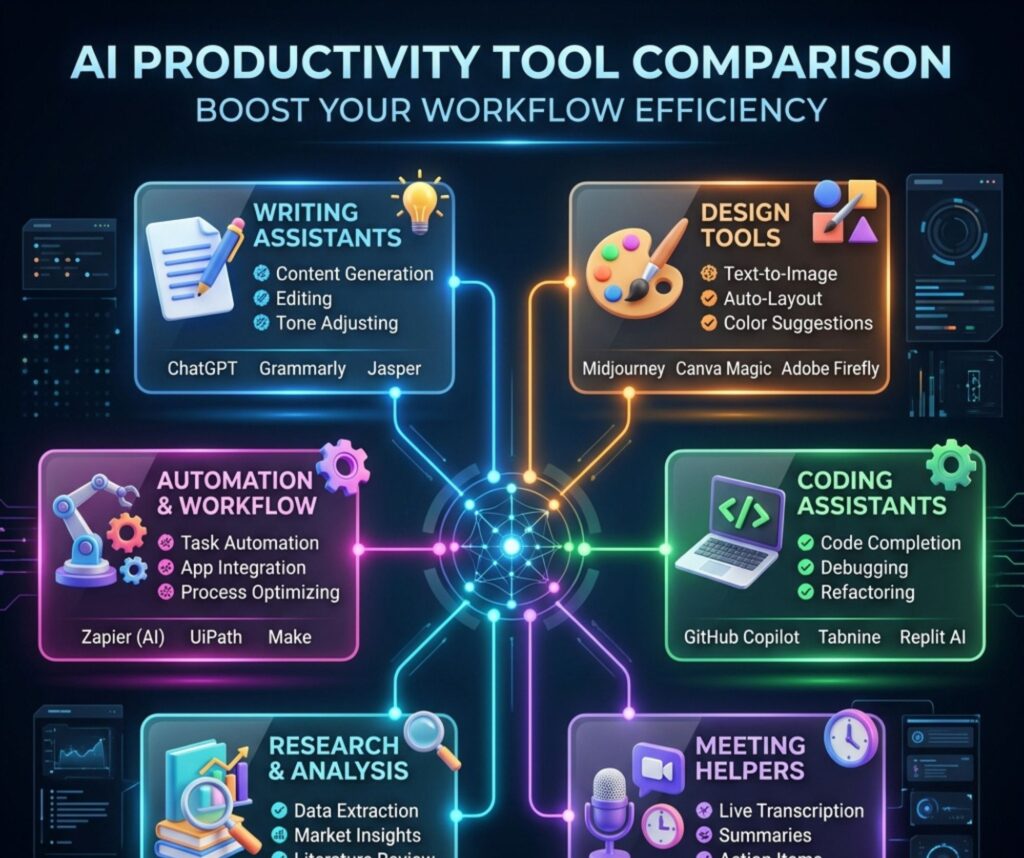
Choosing the right software depends on how well each application supports the others. The most successful companies rarely depend on one solution alone. Instead, they combine specialized platforms that exchange information automatically. This strategy creates Productivity apps for business that support research, communication, planning, automation, and documentation without creating unnecessary complexity. The result is a smarter workplace where technology quietly supports every task.
An effective technology stack also reduces context switching. Instead of opening many unrelated applications, employees move naturally through one connected environment. This combination of AI software for teams, Team collaboration software, and Business automation software creates smoother daily operations while reducing mistakes caused by manual data entry. The following tools represent some of the strongest options available for building a complete AI workflow in 2026.
1. Shift Browser
Shift Browser serves as a powerful Context-aware AI tools platform designed to organize multiple accounts, applications, and workflows inside one browser. Rather than switching between countless tabs, users manage projects, communication, and research from a centralized dashboard. Its built-in AI capabilities support faster searches, intelligent suggestions, and better organization, making it an excellent starting point for a modern AI productivity stack.
2. Asana
Asana remains one of the leading platforms for AI task management and AI project planning. Teams organize assignments, monitor deadlines, and collaborate in real time without losing visibility. Integrated automation helps managers assign work, monitor progress, and identify bottlenecks before they delay important projects. Combined with other AI solutions, Asana becomes a central hub for efficient project execution.
3. Notion AI
Notion AI transforms ordinary note-taking into intelligent knowledge management. The platform creates summaries, drafts documents, organizes research, and improves AI document management with impressive speed. Businesses also use it for AI knowledge management, internal documentation, training materials, and collaborative planning. When connected with project management software, valuable information remains accessible instead of becoming buried inside scattered documents.
4. Microsoft Copilot
Microsoft Copilot enhances Word, Excel, Outlook, and other Microsoft applications through intelligent automation. Users create reports, summarize emails, analyze spreadsheets, and generate presentations much faster than before. This powerful assistant supports AI content creation, Cross-platform productivity, and Enterprise AI solutions, making it a valuable addition for organizations already working within the Microsoft ecosystem.
5. Fireflies AI
Fireflies AI changes the way businesses handle meetings by acting as an intelligent AI meeting assistant. It records conversations, creates accurate AI meeting transcription, highlights key decisions, and automatically generates follow-up tasks. Instead of spending valuable time writing notes, teams can focus on discussions while Fireflies captures every important detail. This improves accountability and ensures that no action item is forgotten after a meeting ends.
6. Zapier
Zapier is one of the most trusted AI automation platform solutions for connecting hundreds of business applications without coding. It helps companies Streamline business workflows by moving data automatically between software. For example, a new lead can instantly create a task in Asana, save customer details in Notion AI, and notify a Slack channel at the same time. This level of Smart business automation reduces manual work while improving consistency across daily operations.
7. Grammarly
Grammarly has become much more than a grammar checker. It is now a reliable AI writing assistant that improves emails, reports, proposals, and marketing content. Its AI suggestions help users write clearly while maintaining a professional tone. Whether creating business documents or client communications, Grammarly supports AI-enhanced workplace practices by reducing errors and improving readability across every platform.
8. Trello
Trello offers a visual approach to AI project management through simple boards, lists, and cards. Its automation features reduce repetitive actions while helping teams organize projects more efficiently. Managers can monitor progress at a glance, assign responsibilities, and automate reminders. Combined with Zapier and Slack, Trello becomes a practical solution for businesses seeking better organization without unnecessary complexity.
9. Slack
Slack serves as one of the leading AI communication tools available today. Instead of relying on long email chains, teams communicate through organized channels that keep conversations searchable and accessible. Integrated notifications from Asana, Zapier, and Fireflies create an AI collaboration platform where updates arrive instantly. This connected approach speeds up decision-making and strengthens collaboration across remote and in-office teams.
10. Evernote
Evernote continues to be a trusted choice for organizing ideas, research, and personal knowledge. Modern AI features improve AI note organization by categorizing information and making searches faster. Whether collecting research for a project or storing meeting summaries, Evernote supports long-term productivity. Together with Notion AI and Shift Browser, it creates a reliable system for capturing and retrieving valuable information whenever needed.
| AI Tool | Primary Purpose | Best For |
| Shift Browser | Workspace Management | Research and multitasking |
| Asana | Project Management | Team planning |
| Notion AI | Documentation | Knowledge sharing |
| Microsoft Copilot | Office Productivity | Documents and spreadsheets |
| Fireflies AI | Meeting Management | Meeting summaries |
| Zapier | Workflow Automation | App integrations |
| Grammarly | Writing Assistance | Professional communication |
| Trello | Visual Task Management | Project tracking |
| Slack | Team Communication | Collaboration |
| Evernote | Note Management | Research and organization |
Best AI Workflow Combinations for Different Types of Users
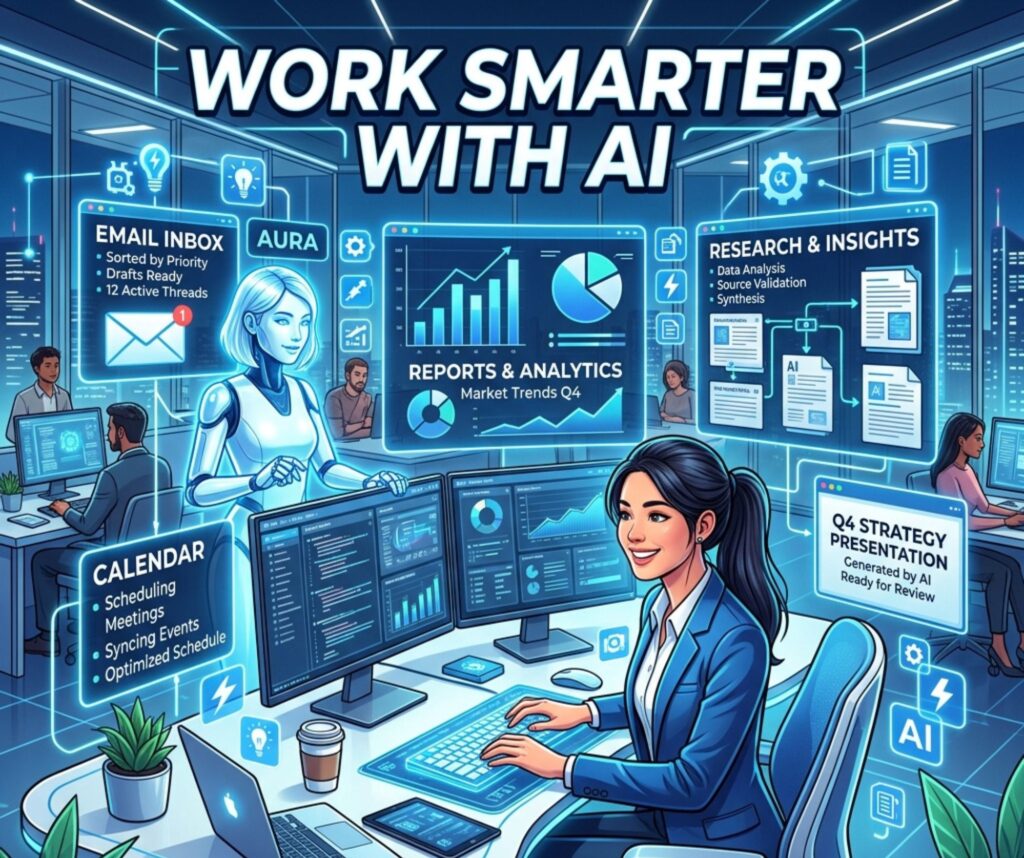
Different professionals need different combinations of Best AI tools. Freelancers often benefit from Shift Browser, Grammarly, Notion AI, and Zapier because these applications simplify writing, research, planning, and automation. Content creators may combine Fireflies AI for interviews, Grammarly for editing, and Microsoft Copilot for document creation. Small businesses usually prefer Slack, Asana, and Zapier because these tools improve communication while automating everyday operations.
Large organizations often require more advanced solutions that support multiple departments. Combining Shift Browser, Microsoft Copilot, Slack, Fireflies AI, Asana, and Notion AI creates a flexible Business productivity ecosystem that scales with business growth. Every application contributes unique strengths while sharing information with the others, creating one efficient digital workplace instead of disconnected software.
How to Build a Seamless AI Productivity Ecosystem Step by Step
Building a connected workflow begins with understanding your daily tasks. Start by identifying repetitive activities that consume unnecessary time. Next, choose applications that naturally connect instead of purchasing unrelated software. Businesses should also prioritize security, ease of use, and long-term scalability before making technology decisions. This thoughtful approach creates a reliable AI-powered workflow without overwhelming employees.
After selecting the right software, connect every application using native integrations or automation platforms such as Zapier. Monitor performance regularly and remove processes that no longer add value. Successful organizations continue refining their systems instead of treating automation as a one-time project. As technology evolves, your Seamless workflow ecosystem should also grow to support changing business needs.
Benefits of Using Multiple AI Productivity Tools Together
Organizations that connect several AI productivity tools enjoy higher efficiency, stronger collaboration, and faster decision-making. Employees spend less time switching between applications because information flows automatically across platforms. Managers also gain better visibility into ongoing projects, making planning and resource allocation much easier. Over time, these improvements increase productivity while lowering operational costs.
Another major advantage is flexibility. Businesses can add new software without rebuilding their entire workflow because integrated platforms share information naturally. This future-ready approach supports innovation while helping organizations adapt to changing customer expectations and emerging technologies.
Common Mistakes to Avoid When Combining AI Tools
Many businesses purchase too many applications without creating a clear strategy. This often leads to duplicate work, higher costs, and employee confusion. Choosing software that lacks integration features also limits productivity because staff must manually transfer information between systems. A connected workflow always performs better than isolated applications.
Another common mistake involves over-automation. Artificial intelligence should support people instead of replacing thoughtful decision-making. Businesses achieve the best results when employees review AI-generated content, monitor automated workflows, and maintain strong security practices throughout every stage of implementation.
How to Choose the Right AI Productivity Stack for Your Needs
Every organization has different goals, budgets, and workflows. Small businesses may prioritize affordability and ease of use, while larger companies often require advanced security and enterprise integration. Selecting software that grows alongside your business helps avoid costly migrations later. Compatibility should always receive as much attention as individual features.
Testing several solutions before full deployment is equally important. Trial periods reveal how applications interact with existing systems and whether employees can adopt them comfortably. The best technology stack supports everyday work naturally without creating unnecessary complexity.
Frequently Asked Questions About AI Productivity Tools
| Question | Short Answer |
| What are AI productivity tools? | Software that uses artificial intelligence to improve efficiency and automate work. |
| Which AI tools work best together? | Shift Browser, Asana, Notion AI, Microsoft Copilot, Fireflies AI, Zapier, Grammarly, Trello, Slack, and Evernote. |
| Are AI productivity tools secure? | Most leading platforms provide enterprise-grade security and compliance features. |
| Can small businesses benefit from AI? | Yes. AI reduces manual work and improves productivity regardless of company size. |
| What is the biggest advantage of AI integration? | Faster workflows, better collaboration, and fewer repetitive tasks. |
Final Thoughts: Creating the Perfect AI Workflow in 2026
The future of work belongs to organizations that embrace connected technology instead of isolated applications. The Top AI Productivity Tools That Work Best Together: Build a Seamless Workflow Ecosystem in 2026 demonstrates how intelligent integration improves collaboration, reduces manual effort, and creates a more efficient workplace. Every featured platform contributes unique strengths while supporting a larger productivity strategy.
Whether you work independently or manage a growing enterprise, investing in compatible AI solutions creates lasting value. By combining automation, communication, documentation, project management, and knowledge sharing into one connected system, you build a smarter digital workplace prepared for the evolving demands of modern business.
