
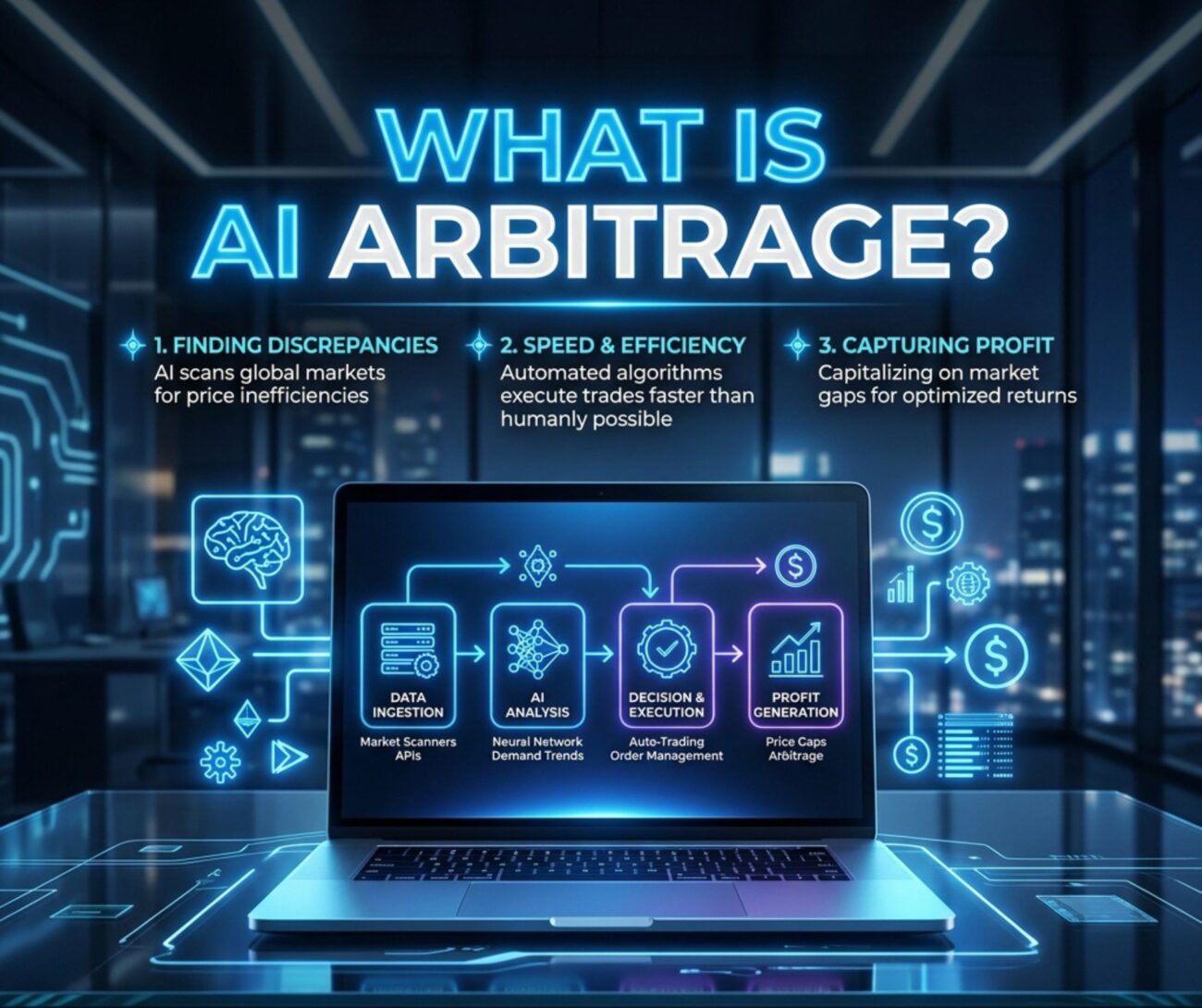
What Is AI Arbitrage refers to the process of using artificial intelligence, automation tools, digital marketing, business efficiency, and profit opportunities to generate income by identifying price, time, or productivity gaps. Instead of creating products from scratch, AI arbitrage leverages smart software to automate repetitive tasks, produce content, analyze data, or deliver services faster and at a lower cost.
Individuals and businesses can then sell these AI-powered solutions at a higher value, earning a profit from the difference. As AI technology continues to evolve, AI arbitrage has become an accessible strategy for freelancers, entrepreneurs, and companies seeking scalable and cost-effective ways to grow online.
What Is AI Arbitrage?
At its core, an AI arbitrage business is about profiting from a gap. It is the difference between what something costs to produce using AI tools and what a client or buyer is still willing to pay for it. The AI part is not the magic trick. The pricing gap is where the real value sits.
Think about it this way. A skill that used to take a person five hours to complete might now take an AI tool five minutes. But the client still expects to pay based on the old price. That mismatch between production cost and perceived value is the entire idea behind arbitrage in this space. It shows up in service work, online reselling, and even trading markets, though each version works differently under the hood.
How Does AI Arbitrage Work?
The mechanism is simple once you see it clearly. You use AI tools to produce an outcome at a lower cost than before. Then you sell that outcome at a price the market already accepts. The client pays based on the value they receive, not on how fast you made it. This gap between cost and price is where your profit margin comes from.
Here is a quick example. Imagine a small business owner who used to pay a freelance writer $500 for a batch of blog posts. Now, using AI copywriting tools, you can produce similar quality content at a fraction of the cost. You still charge close to that $500 rate because that is what the client expects to pay. The client is happy with the result. You keep the difference. That is AI arbitrage working in real time.
What Are the Three Models of AI Arbitrage?

People use the term “AI arbitrage” to describe three very different business models. They all share the same core logic, but the risk, effort, and tools involved are not the same at all. Knowing the difference matters before you pick one to pursue.
The first is the AI-assisted agency model, sometimes called service arbitrage. Here, you offer services like SEO, copywriting, or lead generation, but you use AI to handle most of the production work. The second is retail arbitrage, where AI helps you spot pricing gaps across e-commerce platforms faster than a human ever could. The third is algorithmic and crypto trading, where AI spots tiny price differences in financial markets. This one carries the highest risk and the most passive income scams.
| Model | Barrier to Entry | Risk Level | Common Tools |
| Agency Model (Service Arbitrage) | Low | Low to Medium | ChatGPT, Claude, Surfer SEO |
| Retail and E-Commerce Arbitrage | Medium | Medium | Tactical Arbitrage, Seller Assistant |
| Quantitative and Crypto Trading | High | Very High | Institutional trading systems |
The Agency Model Explained
This model works because clients already know what agency services normally cost. You are not inventing a new price. You are matching an existing one while using AI workflow automation to lower your own production cost. The gap between what you charge and what your tools cost becomes your income.
Retail and E-Commerce Arbitrage Explained
This model is not new. Resellers have done buy low sell high for decades. AI just makes it faster. Tools scan thousands of listings on Amazon and Walmart at once, spotting price gaps a human would miss. Some sellers also use liquidation platforms to find deeply discounted stock before flipping it for profit.
Quantitative and Crypto Trading Explained
Real algorithmic trading and quantitative trading exist inside large financial institutions. These firms use AI to catch market inefficiencies measured in fractions of a cent. This is called high-frequency trading, and it requires massive capital requirements and strict regulatory compliance. Most retail platforms promising automated crypto trading bots with guaranteed returns are not run by real institutional trading desks. Be very careful here.
Why Does the AI Arbitrage Pricing Gap Exist?
The gap exists because of something called labor cost anchoring. For years, clients paid based on how long a task took a human to finish. That price became the standard. AI changed how fast the work gets done, but it has not yet changed what clients expect to pay for it.
This lag will not last forever, though. As clients learn more about AI, they start asking harder questions about pricing. Competitors begin lowering their rates too, which slowly closes the pricing gap. Understanding buyer psychology helps here. People pay based on trust and perceived value, not on the tools used behind the scenes. That is exactly why this window is still open today, even if it will not stay open indefinitely.
How Long Will the AI Arbitrage Opportunity Last?
Nobody can give you an exact expiration date, but the signs of a closing window are already visible. As more people learn about AI-assisted agency work, competition increases and prices start dropping. This is often called market saturation, and it happens in nearly every online opportunity once enough people catch on.
The businesses that survive this shift are not always the first ones in. They are the ones who build real client relationships and specialize deeply in one niche instead of trying to serve everyone. Speed alone is not a lasting competitive advantage once AI tools become common and cheap. What lasts is trust, quality, and consistency, three things that are much harder to copy than a subscription to an AI tool.
How to Get Started With AI Arbitrage
Getting started does not require large amounts of money. The agency model has the lowest barrier of the three, which makes it the best starting point for most beginners in the United States. What it does require is focus, patience, and a willingness to learn quickly.
Start by picking one service inside a niche business model rather than trying to offer everything at once. A tighter focus, like content for small law firms, works better than a broad offer like general writing. Next, choose two or three AI tools that can handle most of the actual production work for you. Price your service based on what the market already pays, not based on your own low costs. Land one paying client first before you try to scale anything further. That first project teaches you more than any course ever will.
Best Tools and Platforms for AI Arbitrage
The right tools depend entirely on which model you choose to pursue. For the agency route, most people rely on a Large Language Model (LLM) like ChatGPT, Claude, or Gemini to handle writing and ideation. Tools like Surfer SEO and Clearscope help with SEO automation and content optimization, while platforms like Apollo.io and Clay support client acquisition and outreach.
For retail sellers, price monitoring tools like Tactical Arbitrage and Seller Assistant scan thousands of products for gaps you could never spot manually. Automation platforms such as Zapier and Make (Integromat) connect these tools together, saving you hours of manual work every week.
| Category | Tool | Best For |
| Content & Copywriting | ChatGPT, Claude, Gemini | Drafting, ideation, editing |
| SEO Optimization | Surfer SEO, Clearscope | On-page content scoring |
| Lead Generation | Apollo.io, Clay | Prospecting and outreach |
| Workflow Automation | Zapier, Make (Integromat) | Connecting tools together |
| Retail Arbitrage | Tactical Arbitrage, Seller Assistant | Price scanning across platforms |
Is AI Arbitrage Legal and Legitimate?
Yes, the agency and retail models are completely legal in the United States. These businesses work the same way traditional agencies and resellers always have. The only real difference is the tools being used behind the scenes to lower production cost.
That said, honesty matters here. If a client asks whether the work is human made and you lie about it, that becomes a reputational risk, not just an ethical one. Proper AI-generated content disclosure protects you and builds trust with clients long term. Trading and crypto platforms are a different story entirely. Many offers promising guaranteed returns through crypto trading bots are outright passive income scams. If you are ever wondering is AI arbitrage a scam, the trading category is where most of the fraud actually lives, not the service or retail side. A genuine legitimate online business built on the agency model has nothing to hide.
Pros and Cons of AI Arbitrage
Like any business model, AI arbitrage comes with real upsides and real downsides. Weighing both sides honestly will help you decide if this path fits your goals and risk tolerance.
| Pros | Cons |
| Low startup cost for the agency model | Market correction can shrink margins over time |
| Access to scalable income without a large team | Heavy reliance on AI pricing staying low |
| Works across many industries and niches | AI commoditization makes differentiation harder |
| No need for coding or technical skills | Reputational risk if AI use is hidden from clients |
| Flexible schedule and remote friendly | Increasing competition as more people enter the space |
Common Mistakes to Avoid in AI Arbitrage
Many beginners make the same errors, and most of them are avoidable with a little planning. The biggest mistake is underpricing your service just because your own production cost is low. Remember, clients pay for outcomes, not for your internal cost structure. Match your freelance pricing to the market rate, not to your expenses.
Another common mistake is skipping quality control on AI-generated work before sending it to a client. AI output still needs a human eye for accuracy and tone. Ignoring client communication about how you use AI tools can also damage trust once a client finds out on their own. Ethical operators build stronger, longer lasting client relationships by being upfront from day one. Avoiding these small mistakes early on protects both your income and your reputation.
Final Thoughts
AI arbitrage is not a trend that will disappear overnight, but it is also not a guaranteed path to riches. It is a real pricing gap created by fast-moving Automation and slow-moving buyer expectations. The service and retail models offer a legitimate, low-risk way to build a real business today. The trading side, however, is where caution matters most.
If you are ready to start, the agency model remains the easiest entry point. Pick one skill, pair it with the right AI workflow automation tools, and focus on building trust with your very first client. That relationship, more than any tool, is what will carry your business forward.
Frequently Asked Questions
Is AI arbitrage a scam?
No, not by default. The agency and retail models are legitimate business practices. The trading and crypto side of AI arbitrage is where most passive income scams exist.
How much money can you make with AI arbitrage?
It depends heavily on your niche, pricing, and client base. There is no fixed number, and anyone promising guaranteed income should raise a red flag.
Do you need coding skills for AI arbitrage?
No. Most tools used in the agency and retail models require no technical background at all.
What is the best AI arbitrage model for beginners?
The agency model, since it has the lowest capital requirements and the fastest path to landing a first client.
Is AI arbitrage saturated yet?
Not completely, but market saturation is increasing as more people learn about the opportunity. Acting with a clear niche strategy still gives you an edge today.
